

Here’s something most people get wrong. Ask anyone on the street what’s the highest degree a surgeon can earn in India, and they’ll almost always say MS. It sounds right. It’s what everyone repeats. But it’s not the full answer.
There’s one more step. One final peak above MS that only a small number of surgeons ever climb. It’s called MCh, and it’s what separates a great surgeon from a true master of surgery.
In this guide, I’ll walk you through everything about it. The MCh full form, what the course actually looks like, how many years it takes, what it costs, and the kind of career waiting at the end. No complicated words. No sugarcoating. Just the real picture, straight up.
If you’re a medical student with big ambitions, or just curious about what it takes to become India’s top-level surgeon, this one’s for you. Let’s dive in.
What is the MCh Full Form?
MCh stands for Master of Chirurgiae. In Latin, it’s called Magister Chirurgiae, which also translates to Master of Surgery.
Now here’s the important part. This is not a regular degree. It’s a super-speciality degree, which means it sits one level above MS. Think of it like a staircase. MBBS comes first. Then MS in General Surgery. Then MCh, where you master one single surgical field deeply, like neurosurgery or heart surgery.
In simple words, an MS surgeon operates on many body parts. An MCh surgeon becomes the absolute expert in one specific area. That’s why it’s considered the highest qualification in surgical education in India.
MCh Course Duration: How Long Does It Take?
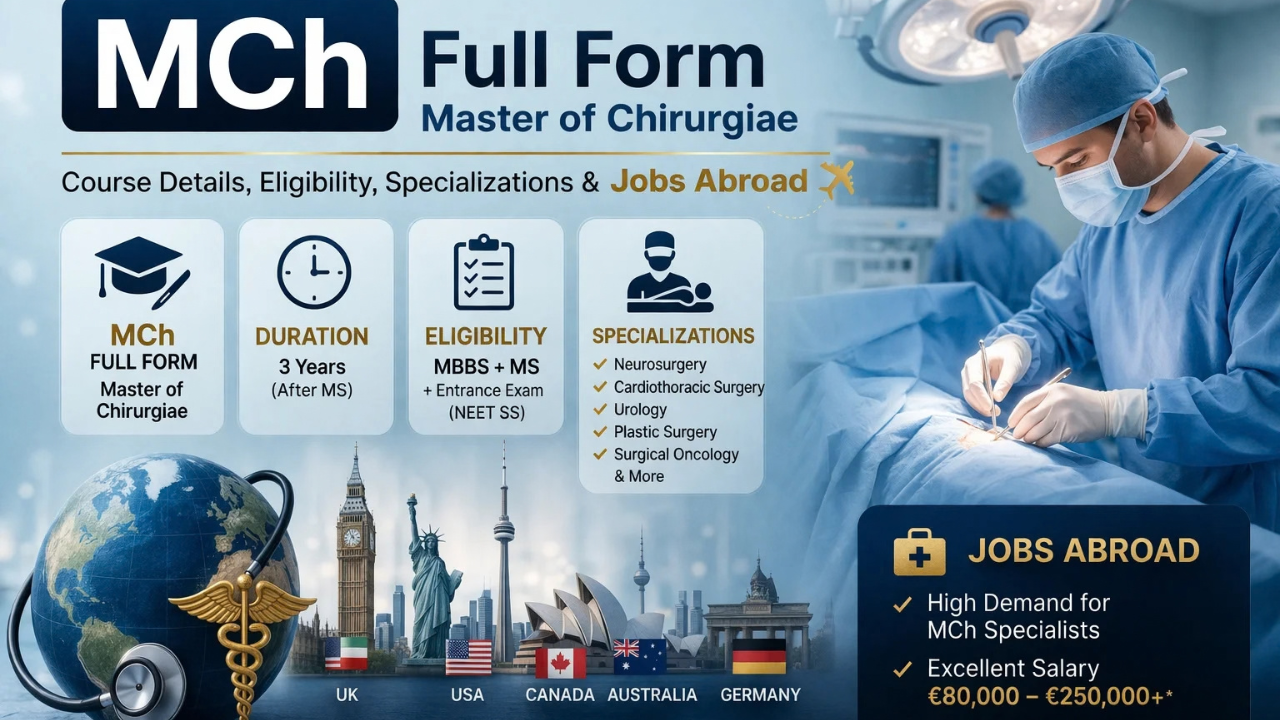
The standard route takes 3 years after completing MS or DNB in General Surgery.
But there’s a shortcut some institutes offer. Places like AIIMS Delhi run direct 5- to 6-year MCh programs that students can join right after MBBS, skipping the MS step. These are rare and extremely competitive, but they exist.
Who Can Apply for MCh? Eligibility Explained
The requirements are strict, and honestly, they should be. You’re dealing with life-and-death surgeries here.
You need an MS or DNB degree in General Surgery or a related field from a recognized institution. You also need registration with the National Medical Commission or your State Medical Council. And finally, you must clear the entrance exam, which brings us to the next point.
Entrance Exams for MCh Admission
There are two main exams. The first is NEET SS, which is the single national entrance exam for super-speciality courses like MCh and DM. It’s conducted by the National Board of Examinations.
The second is INI CET, which is the entrance test for AIIMS, PGIMER Chandigarh, JIPMER, and NIMHANS. Some institutes also conduct their own exams on top of these .
Fair warning. These exams are brutal. Only a small number of candidates clear them each year, which is exactly why MCh seats are so precious.
Popular MCh Specialisations
Here’s where it gets interesting. MCh lets you pick one surgical field and go incredibly deep into it. The most popular options include:
Neurosurgery — surgery on the brain and nervous system
Cardiothoracic Surgery — surgery on the heart and chest
Urology — surgery of the urinary system
Plastic and Reconstructive Surgery — repairing and rebuilding body parts
Pediatric Surgery — surgery on babies and children
Surgical Oncology — cancer surgery
Vascular Surgery — surgery on blood vessels
Gastrointestinal Surgery — surgery on the digestive system
Each one takes years to master, which is why MCh training is so intense.
MCh Course Fees in India
The fees swing wildly depending on the institute. Government colleges like AIIMS and PGIMER charge very little, sometimes just a few thousand rupees a year. Private institutions charge much more, with total course fees ranging between ₹3 lakh to ₹12 lakh on average.

If you manage a government seat after clearing NEET SS, you’ll get world-class training at almost no cost. That’s one more reason these exams are worth the grind.
MCh Salary in India: What Can You Earn?
Now the numbers.
The average salary of an MCh graduate in India ranges between ₹12 lakh to ₹25 lakh per year, depending on the specialisation and experience. Experienced super-specialists in private hospitals, especially neurosurgeons and cardiac surgeons, can earn far more than that.
And this doesn’t even count private practice. Many MCh surgeons run their own clinics alongside hospital work, which adds a significant income on top. It’s one of the few careers where your earning potential keeps rising for decades.
MCh vs MS vs DM: Quick Difference
This confuses many people, so let’s clear it up in simple words.
MBBS is the starting degree. Everyone begins there. MS is the postgraduate degree in surgery. MCh is the super-speciality degree after MS, focused on one surgical field. DM is similar to MCh but for medical fields instead of surgery, like cardiology or neurology.
So if you want to be a surgeon, your path is MBBS to MS to MCh. If you want to be a medical specialist, it’s MBBS to MD to DM.
Other Meanings of MCH
MCH also means two other things outside of this degree.
The first is Mean Corpuscular Hemoglobin, which is a value in your blood test report. It shows the average amount of hemoglobin in each red blood cell, and the normal range is roughly 27 to 33 picograms.
The second is Maternal and Child Health, a term used in public health programs that focus on the health of mothers and children.
But when someone searches “MCh full form” in the education context, they almost always mean the surgical degree.
Final Word
The MCh full form is Master of Chirurgiae, the highest surgical degree in India. It’s a 3-year super-speciality program after MS, entered through NEET SS or INI CET, and it turns already-qualified surgeons into true masters of their field.
Is it hard to get? Extremely. Is it worth it? If surgery is your calling, absolutely. Not many careers let you hold someone’s life in your hands and hand it back to them repaired. That’s what an MCh surgeon does every single day.
If you’re a medical student dreaming of this path, start preparing early. The road is long, but the destination is worth every sleepless night.
Read More: Paramedical Courses in India: List, Fees, Eligibility, Admission & Career Scope
